Traces of Motion
Feb 27 - Mar 27
Gianluca Bianchino · Janos Korodi · Lisa Lackey
Opening Reception: Friday, February 27, 6-8pm
368 Broadway, Suite 409, New York, NY
Please RSVP: info@elzakayal.com
About
This spring, three distinct artistic voices converge in a group exhibition that explores how humans navigate, construct, and ultimately imprint themselves upon the world. Moving across disciplines, materials, and conceptual frameworks, the exhibition examines the layered relationship between natural systems, industrial environments, and the human body as both observer and participant. Through immersive abstraction, industrial poetics, and deeply human figurative symbolism, Gianluca Bianchino, Janos Korodi and Lisa Lackey present bodies of work that examine landscape not only as physical terrain, but as psychological, technological, and emotional territory.
Together, these three artists construct a layered narrative: Bianchino maps the structural and cosmic systems that surround us, Korodi captures the momentum and infrastructure of human transit, and Lackey returns us to the physical body as origin point and witness. The exhibition invites viewers to consider how landscapes are formed—through natural forces, industrial development, and the cumulative weight of human passage.
Artists
Gianluca Bianchino’s work occupies a space between science and poetry. Born in Avellino, Italy, and now based in Northern New Jersey, Bianchino’s practice is shaped by early experiences with natural catastrophe and migration. His multimedia installations and sculptural works investigate the tension between chaos and order, drawing from geology, architecture, and physics. In this exhibition, Bianchino presents works that evoke abstract geographies and mechanical landscapes—environments that appear both natural and engineered, ancient and futuristic. Optical effects, industrial materials, and layered surfaces suggest satellite imaging, star maps, or speculative topographies. His work proposes that the built environment and natural systems share an underlying geometry, inviting viewers to consider how we attempt to rationalize forces larger than ourselves.
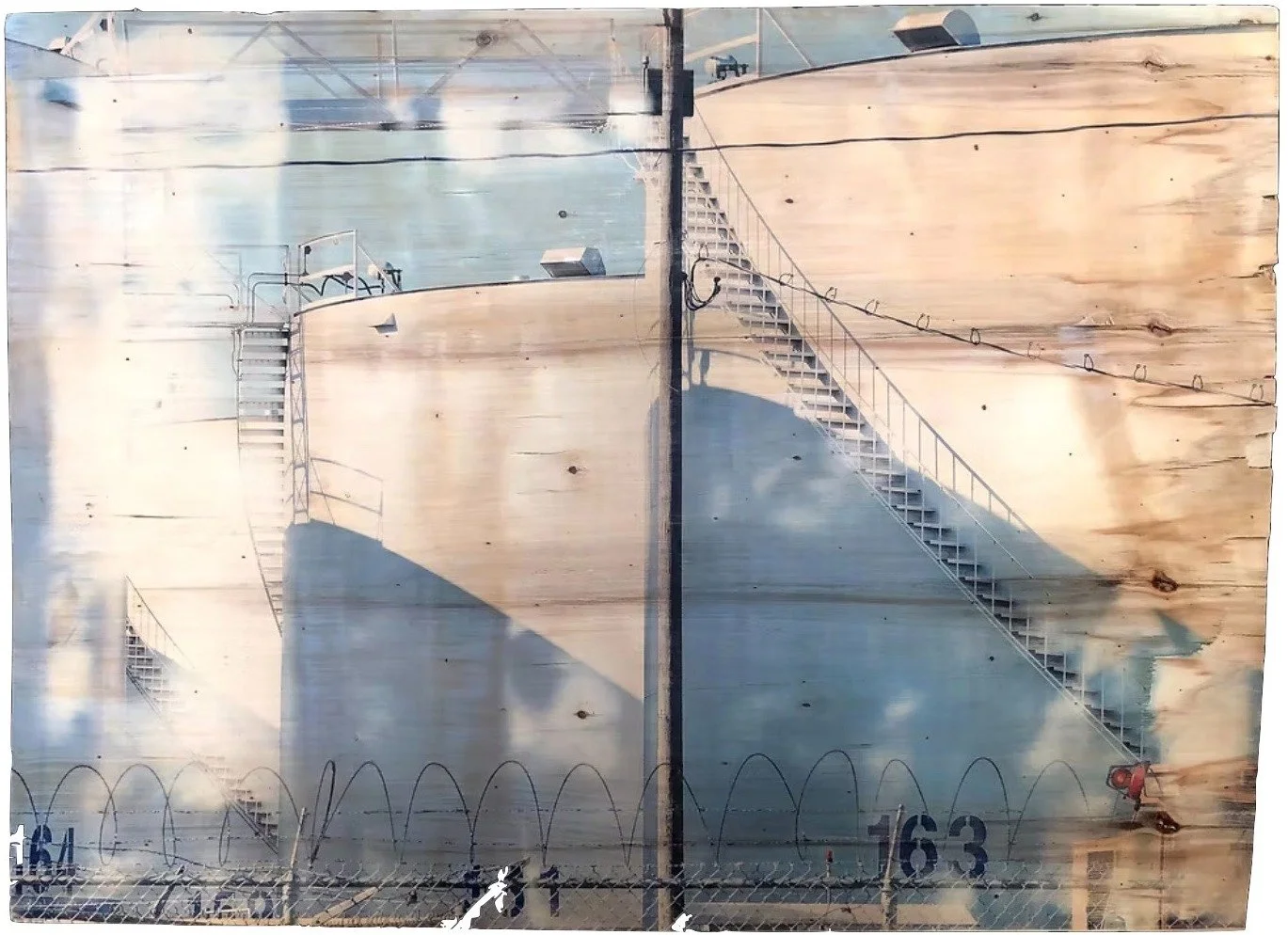
Hungarian-born, Philadelphia-based artist Janos Korodi contributes work from his evolving Motion Series, alongside paintings inspired by bridges and industrial oil tank structures. The exhibition also includes works from his Light Works Terminal series, which focuses specifically on oil tanks observed in industrial zones along the Delaware River and Northeast Philadelphia. In these works, Korodi captures the shifting interaction of sunlight, shadow, and surface across massive cylindrical forms, transforming utilitarian structures into poetic studies of light, time, and repetition. Korodi’s broader practice emerges from decades of engagement with architecture, urbanism, and the concept of genius loci—the spirit of place. Drawing source imagery from technological tools such as Google Street View and translating them back into physical paint, wood, and pigment, Korodi explores how contemporary life is experienced through layers of mediated movement. Through techniques that merge painterly gesture with algorithmic visual logic, Korodi collapses the boundary between abstract and representational space, presenting motion as both physical and psychological condition.
Lisa Lackey, an architectural engineer and visual artist living and working in New York and New Jersey, grounds the exhibition in the intimate scale of the human body. Working primarily with textiles, Lackey constructs figurative works that transform everyday materials into powerful metaphors of shared experience. Her work Finding Balance exemplifies her central theme: the human footprint on the world, both literal and symbolic. Using cloth—the material that shelters, protects, and accompanies us through daily life—she creates images of shadows, feet, and human presence that become universal rather than individual. Lackey’s dual background in engineering and art informs her sensitivity to structure, weight, and spatial relationship, while her material choices root the work in emotional and physical reality.